
Casino Wagering Requirements Explained
Understand bonus-only and deposit-plus-bonus wagering, game contribution and the conditions to check before withdrawing.

Choosing the bonus with the lowest wagering multiplier isn't a reliable shortcut. A smaller multiplier can apply to a larger balance, exclude the games a player prefers, or come with withdrawal conditions that make the headline offer less useful. The calculation base matters as much as the advertised multiplier, and completing turnover isn't the same as having money available to withdraw.
What a Casino Wagering Requirement Actually Means
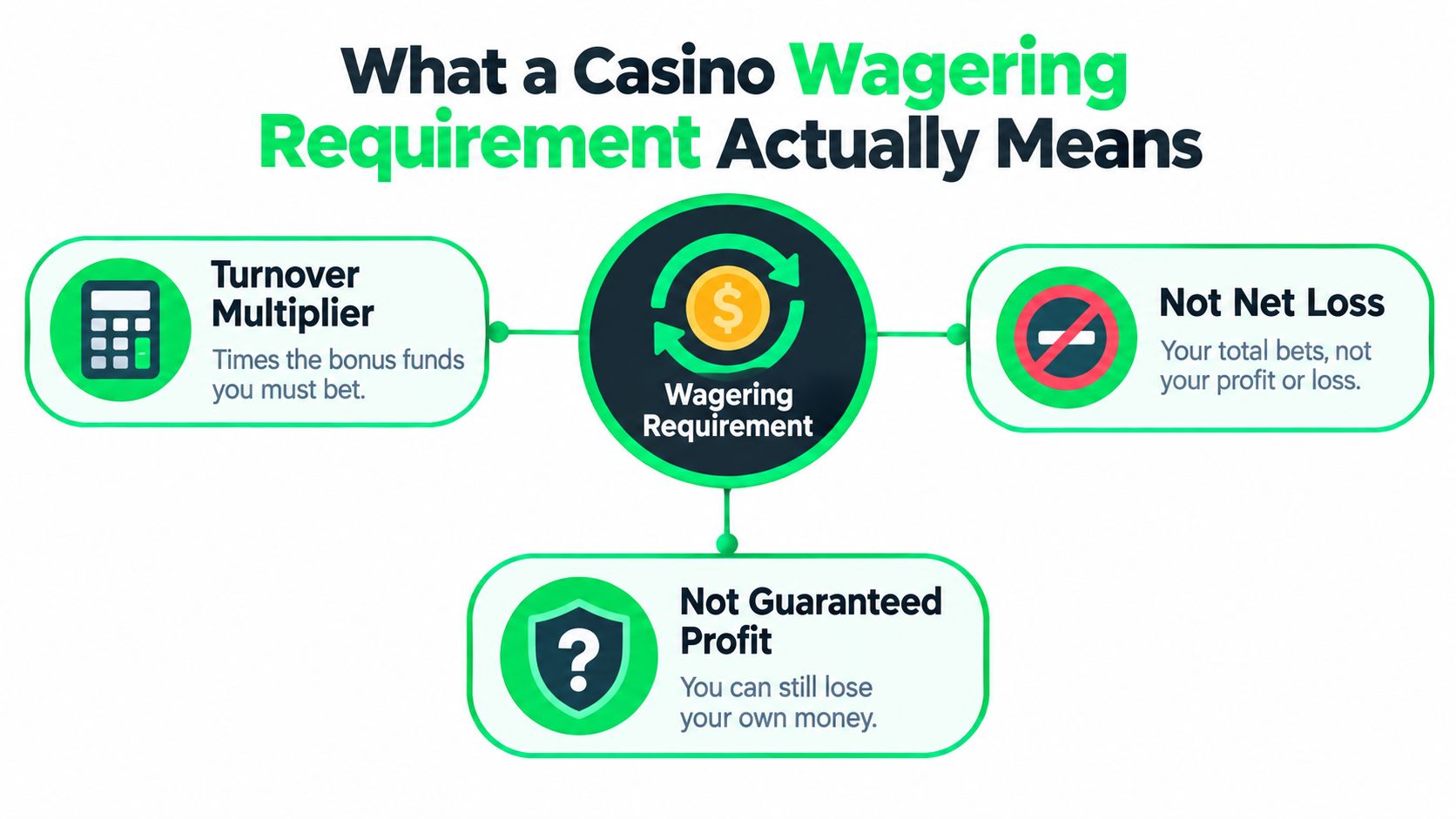
A wagering requirement is a turnover condition, usually expressed as a multiplier, that determines how much must be staked before bonus-related funds become withdrawable. The practical question is whether that multiplier applies to the bonus alone or the deposit plus the bonus, and what else must happen before a withdrawal becomes possible.
The word turnover means cumulative qualifying stakes. It doesn't mean the player must lose that amount, deposit that amount, or finish with that amount in the account.
Returned winnings can be staked again and contribute towards turnover if the promotion permits those wagers. The account balance may rise or fall while the recorded total of qualifying stakes increases.
The distinction between stakes and results
A wagering target measures activity, not success. A player can make progress towards the target while losing money, and completing it doesn't guarantee that any balance remains.
The basic concepts are separate:
Deposit balance: Money the player has added to the account, subject to the applicable account and withdrawal rules.
Bonus balance: Promotional funds whose use and withdrawal depend on the promotion's conditions.
Qualifying turnover: Stakes credited towards the wagering requirement.
Withdrawable balance: Funds currently eligible for withdrawal after applicable conditions have been satisfied.
The conceptual distinction matters before any calculation begins.
RTP doesn't predict a playing session
Return to player, or RTP, is a long-run theoretical average, not a promise about an individual player's results. It shouldn't be read as the proportion of a particular deposit that will come back.
Actual results can differ substantially from a theoretical average. A player may lose the available balance before completing the wagering requirement, even when the selected game appears attractive on paper.
Practical rule: A wagering target describes required betting activity. It doesn't describe a safe budget, a likely final balance, or a route to guaranteed profit.
The arithmetic below is jurisdiction-neutral, but the availability and legality of a promotion aren't. Before opting in, an eligible adult should check the applicable market terms, calculation base, eligible games, expiry conditions and withdrawal rules.
Bonus-Only vs Deposit-Plus-Bonus Formulas
The clearest comparison starts with identical deposit and bonus amounts. Changing only the calculation base reveals why similar-looking promotions can require different amounts of play.
The formulas are straightforward:
Bonus-only wagering: Bonus amount × wagering multiplier.
Deposit-plus-bonus wagering: (Deposit amount + bonus amount) × wagering multiplier.
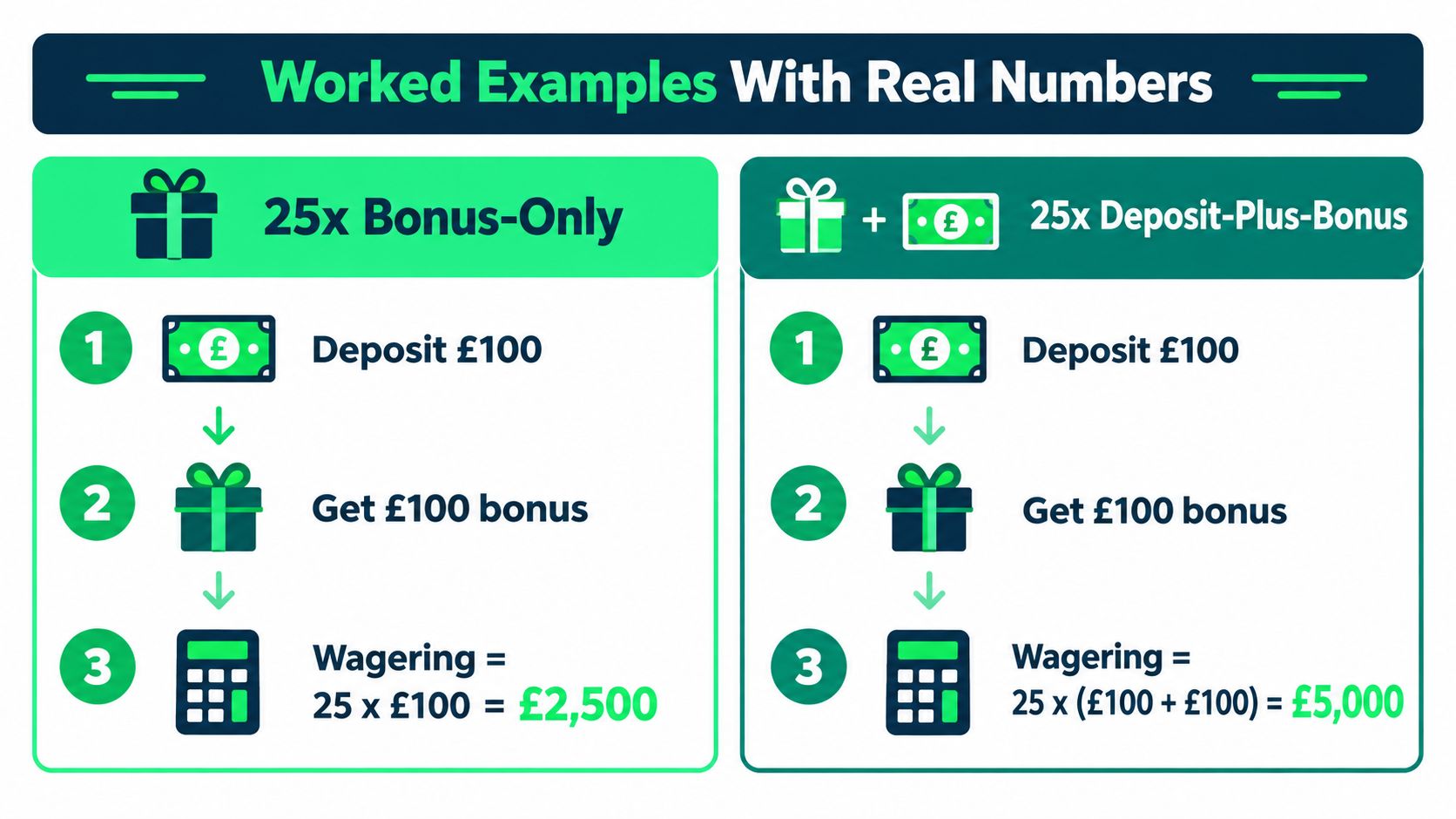
For a £100 deposit and £100 bonus, the starting balance is £200. Applying 25x to the bonus alone creates £2,500 in qualifying turnover, while applying it to the combined balance creates £5,000, illustrating the calculation-base distinction explained alongside the Gambling Commission's guidance on safer, simpler gambling promotions.
Bonus-Only vs Deposit-Plus-Bonus at a Glance
The comparison uses the amounts and arithmetic above. The final column shows how a different advertised multiplier would be applied, rather than suggesting that either structure is currently available.
| Calculation base | Formula | Turnover at 25x | Turnover at 35x |
|---|---|---|---|
| Bonus only | Bonus × multiplier | £2,500 | £3,500 |
| Deposit plus bonus | (Deposit + bonus) × multiplier | £5,000 | £7,000 |
The combined-base structure produces the larger target when the deposit, bonus and multiplier are otherwise identical. The player hasn't received a larger bonus, but must generate more qualifying stakes.
The table's purpose is to separate what gets multiplied from how many times it gets multiplied. Comparing multipliers without comparing their bases leaves out an essential part of the calculation.
How to read ambiguous promotional wording
Terms such as playthrough, wagering and turnover can describe the same general obligation. None of those words alone identifies the calculation base.
A player should look for an explicit statement that the requirement applies to the bonus, the deposit and bonus, or another specified amount. If the promotion's summary and detailed terms appear inconsistent, clarification should come before acceptance.
A useful comparison record contains:
The base in words: Bonus only, combined deposit and bonus, or another clearly defined base.
The base as an amount: The actual balance used in the formula.
The multiplier: The figure applied to that base.
The resulting target: Required qualifying turnover before contribution adjustments.
A smaller target means less qualifying turnover under otherwise identical conditions. It doesn't establish that a promotion is fairer, cheaper overall or suitable for a particular player.
Worked Examples With Real Numbers
The examples below use the comparison already established. They aren't current promotional claims, player results or predictions of what an account will contain after play.
The important habit is to write down the base before doing any multiplication. That makes it harder to mistake the account's total starting balance for the amount the promotion uses.
Following the bonus-only calculation
For the bonus-only example above, the deposited money isn't included in the multiplication. The bonus amount is the calculation base, and the resulting turnover target is the smaller figure in the comparison table.
The player should then ask whether every selected stake qualifies in full. Without that confirmation, the calculated target describes required credit, not necessarily the total amount that will be staked.
Progress should be checked against the operator's credited turnover, where available, rather than estimated from changes in the account balance. A balance falling during play doesn't prove that an equivalent amount of wagering progress has been recorded.
Following the combined-base calculation
For the deposit-plus-bonus example, the deposited money is added to the bonus before multiplication. That is why the turnover target is larger despite the identical promotional credit.
The player shouldn't interpret that larger target as an instruction to deposit the entire turnover amount. Repeated qualifying wagers can use money returned from previous bets, although there's no guarantee that the balance will last long enough.
A separate illustration shows why small bonuses also deserve careful reading. A £10 bonus with a 50x requirement produces £500 of turnover, as illustrated in the regulatory material linked in the preceding section; this is a historical calculation example, not a statement about a currently permitted offer in every jurisdiction.
Adding expected cost without predicting the outcome
Expected cost is a different calculation from required turnover. In a simplified example, $1,500 of turnover through a game with a 4% house edge produces an approximate mathematical expected loss of $60, before contribution limits, expiry, taxes or other complications; the calculation and consumer-understanding context appear in the Behavioural Insights Team's work on gambling promotions.
That result isn't a forecast of a particular session. Variance means actual losses can be greater or smaller, and a player can run out of funds before completing the assumed turnover.
Bet-count estimates: These require a stated stake size and a confirmed contribution rate.
Completion-time estimates: These also require assumptions about playing pace, breaks and whether play remains affordable.
Expected-loss estimates: These require a relevant house-edge assumption and a clear statement of what the model excludes.
No fixed completion time follows from the multiplier alone. Increasing stakes to meet a deadline changes the amount at risk and may breach the promotion's limits.
A mathematically correct turnover calculation can still describe an unsuitable promotion. Affordability and willingness to stop matter more than finishing a progress bar.
How Game Contribution and Bet Limits Change the Real Cost
A qualifying-turnover target isn't always the same as the amount a player must stake. Game contribution determines how much of an eligible wager receives credit towards that target.
Some games or bet types can contribute partially or not at all. The promotion must therefore be read at the game and wager level, not merely by broad category.
Contribution changes the amount of play required
The practical calculation is:
Required actual stakes = qualifying turnover target ÷ contribution rate expressed as a decimal
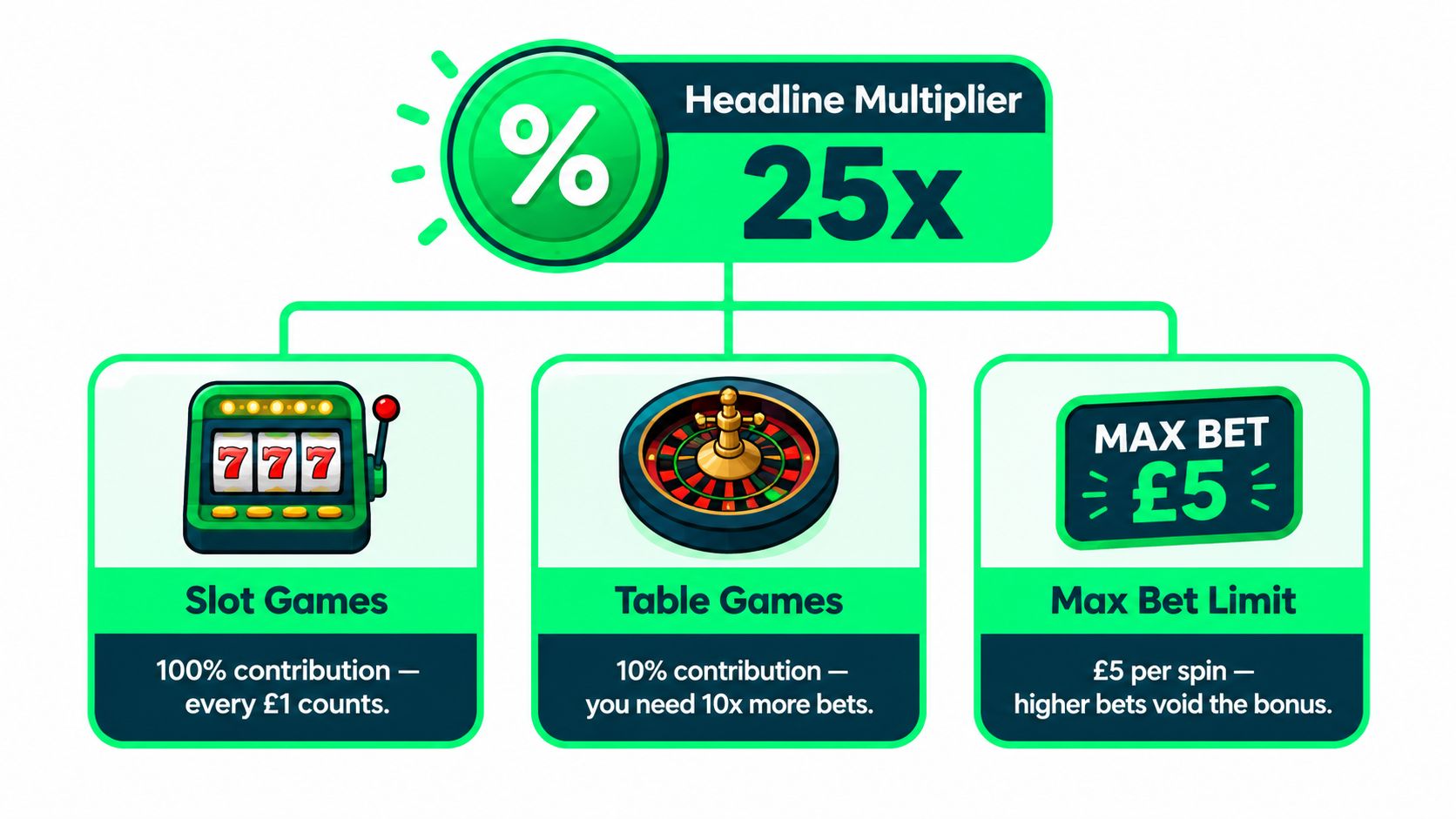
A lower contribution rate means more actual stakes are needed to obtain the same credited turnover. A non-contributing game provides no progress towards the requirement, even if the player can access and play it.
The illustration below demonstrates how contribution and bet-limit conditions can affect a promotion. Its example rates and limit aren't verified terms for a current offer, and shouldn't be treated as standard rules for slots, table games or any particular brand.
A familiar game name doesn't establish eligibility. The exact title, version, feature or bet type may matter, so a player should use the promotion's own eligibility information rather than a general assumption about the category.
Maximum bets are conditions, not suggestions
A maximum-bet rule limits the permitted stake while relevant promotional conditions apply. A player shouldn't assume that a wager is permitted because the game interface accepts it.
The consequences of exceeding a limit must be checked in the actual terms. It would be misleading to claim that every breach has the same result, or that an accidental breach is automatically ignored.
A careful pre-play review distinguishes several questions:
Eligible game: Does this exact game count towards the promotion?
Contribution rate: How much credit does each qualifying stake receive?
Permitted wager: Are particular bet types, features or stake combinations restricted?
Maximum stake: What limit applies, and what does the operator count as the total bet?
Breach consequences: What do the terms say happens if the player exceeds that limit?
Lower contribution can outweigh a lower house edge
A game's theoretical cost and its promotional contribution shouldn't be assessed separately. A lower house edge doesn't necessarily make a game cheaper for clearing a bonus if substantially more turnover is required.
Likewise, a fully contributing game isn't automatically suitable. The player still needs to understand its rules, potential losses and the promotion's restrictions.
The useful comparison is expected cost across the required eligible turnover, not the most appealing individual number. Where the necessary information is unavailable, an exact cost estimate would create false confidence.
Withdrawal Conditions Beyond Turnover
A completed wagering counter answers a narrow question: whether the recorded stake-volume requirement has been met. It doesn't establish that bonus conversion is complete, the account is verified, or a positive withdrawable balance remains.
These are separate checks. A player can finish the required turnover with no money left, or still have funds whose withdrawal depends on another valid condition.
A withdrawal-readiness checklist
Before requesting a cashout, the player should confirm:
Turnover completion: The operator has credited all qualifying wagers and shows no remaining playthrough.
Bonus conversion: The terms explain what becomes cash, what remains restricted and whether any promotional amount is removed.
Available cash balance: The account identifies an actual amount eligible for withdrawal.
Verification status: Any applicable identity and payment checks have been resolved.
Cashout conditions: Any minimum withdrawal amount and permitted withdrawal route have been checked.
Promotion cancellation: The player understands whether requesting a withdrawal ends an active offer.
Expiry status: Relevant deadlines haven't been missed.
This isn't a promise that every promotion has every condition. It is a checklist of questions that should be answered from applicable terms.
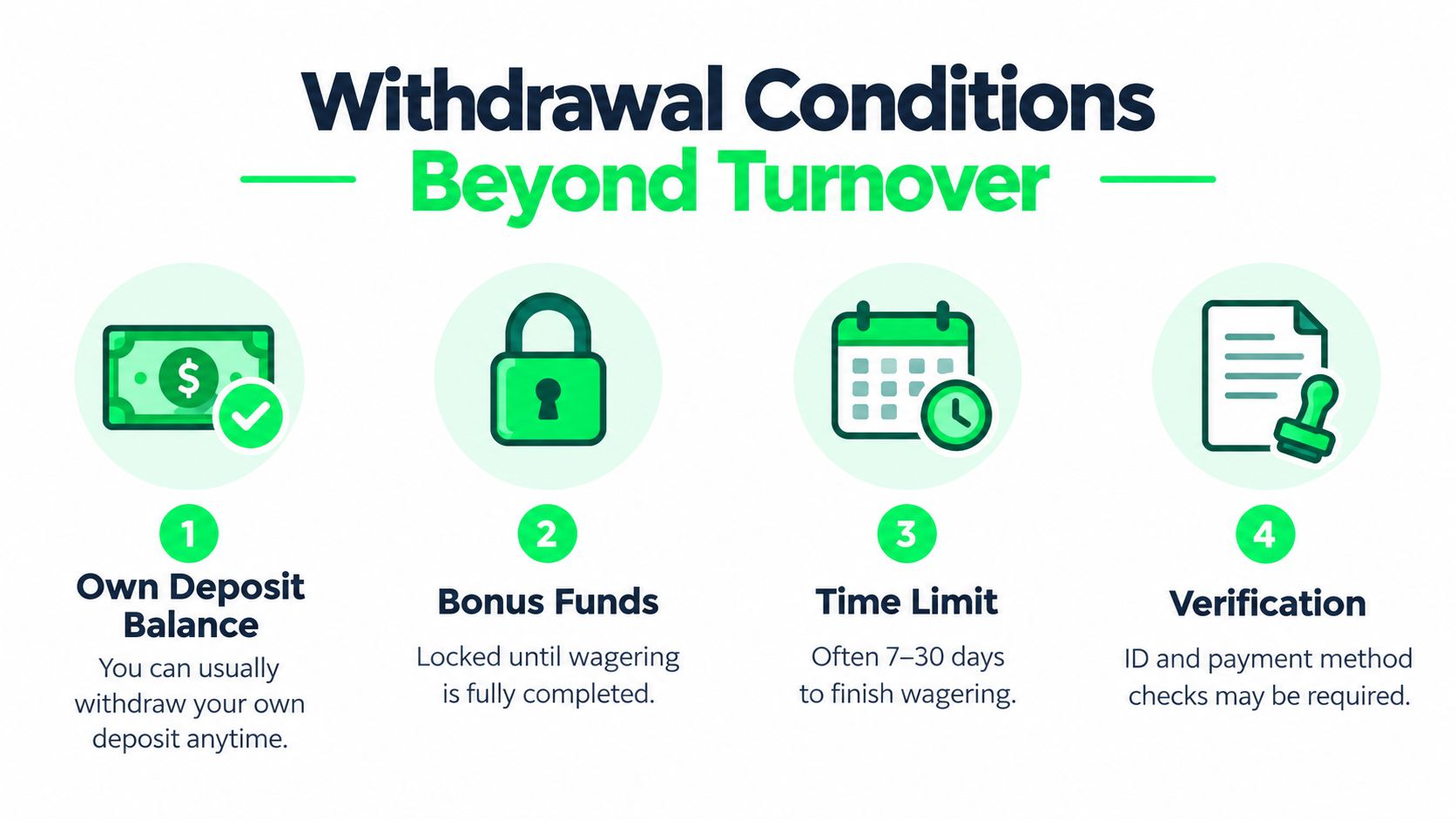
The illustration below highlights common areas to inspect. Its suggested timeframe and general wording shouldn't replace the specific deadline or jurisdictional rules governing an account.
The player's own money needs separate treatment
Under the UK framework, operators must allow players to withdraw their deposit balance at any time, including while a bonus is pending or active, without first imposing wagering on that deposit balance. The same guidance distinguishes deposit-funded winnings from restricted bonus funds and sets out the need for clear, accessible incentive terms in the Gambling Commission's fair and transparent terms guidance.
That is a jurisdiction-specific protection, not a universal description of every market. The applicable local framework must be identified before drawing conclusions about a particular account.
What to ask when cashout remains unavailable
A useful support question identifies the missing condition rather than reporting that withdrawal doesn't work. The player can ask which balance remains restricted, what clause applies, and what action is still required.
Keeping a copy of the accepted promotional terms and relevant account messages can help make that exchange precise. A payment estimate, bonus estimate or progress display shouldn't be treated as confirmation that a withdrawal has been approved.
Why a Lower Multiplier Is Not Always Better
A multiplier only becomes meaningful after the calculation base and contribution rules are known. Ranking offers by that figure alone can favour a promotion that requires more actual play.
A combined-base offer with a lower multiplier may impose more turnover than a bonus-only offer with a higher multiplier. Restrictions can widen that difference further if the player's preferred games contribute less.
Compare the conditions the player will actually use
The useful question isn't which promotion looks best under ideal assumptions. It is which, if either, fits the player's intended games, affordable spending and available time.
| Comparison point | What matters |
|---|---|
| Calculation base | The amount being multiplied |
| Eligible play | The exact games and wagers the player intends to use |
| Contribution | Credit received for those wagers |
| Expiry | Whether completion would create pressure to play |
| Maximum bet | Compatibility with the intended stake |
| Withdrawal treatment | What becomes withdrawable and what may be removed |
A generous-looking deadline doesn't make an offer affordable. A short deadline also shouldn't become a reason to accelerate play, increase stakes or chase losses.
Expiry pressure is part of the decision
A player may understand the arithmetic and still underestimate the inconvenience of completing eligible turnover. Work, sleep, breaks and a decision to stop all matter more than retaining promotional credit.
An offer that requires uncomfortable changes in playing habits isn't improved by an attractive headline. Declining it can be the better decision.
Consumer understanding also warrants caution. Only 71% of surveyed consumers agreed that they understood how promotional winnings could be withdrawn, according to the Gambling Commission's research on consumer understanding of promotional offers.
Comparison principle: Promotions should be compared using the games, stakes and time the player would genuinely choose, not the conditions required to make the advertisement look attractive.
Use a complete comparison, not a score
A useful side-by-side review records the calculation base, contribution-adjusted turnover, expiry, stake restrictions and cashout conditions. It should also identify unanswered questions rather than hiding them behind a single estimated value.
If an offer cannot be understood without guessing, the comparison is incomplete. No bonus is worth treating uncertain terms as favourable terms.
Choosing the Right Offer at FungaBet
Choosing a promotion should begin with the terms, not with activation. A bonus-only structure and a deposit-plus-bonus structure can both be described clearly, but neither label provides enough information on its own.
The betting odds guide can support background reading. The current promotion page and applicable account terms remain the documents that determine an individual offer.
Build a short promotion record
A player can turn a long terms page into a practical record without reducing it to the headline multiplier.
Calculation base: Record exactly which funds the multiplier applies to.
Turnover target: Preserve the formula as well as its result, so an incorrect base remains visible.
Game eligibility: List the intended games and their stated contribution rules.
Stake restrictions: Note the maximum permitted bet and any excluded wager types or features.
Expiry: Record the actual deadline and what the terms say happens when it passes.
Cashout treatment: Separate bonus conversion, cash balance and unresolved withdrawal conditions.
The purpose isn't to create a strategy for beating the promotion. It is to establish whether the obligation is understandable and acceptable before money is committed to play.
Verify the offer that actually appears
A general casino guide cannot establish a current bonus amount, minimum deposit, currency, payment method, licence, withdrawal time or game feature. Those details need current, approved information relevant to the player's account and market.
A player should also avoid combining conditions from different regional offerings. Terms found for one market, currency or payment route don't establish availability elsewhere.
For any registration or payment decision, the relevant checks are practical:
Eligibility: The player meets the age and location conditions.
Account details: Registration information can be supported by the required documents.
Payment terms: The chosen method is currently accepted for the intended transaction.
Withdrawal route: Cashout conditions are understood before depositing.
Unclear wording: Questions are resolved before opting into the promotion.
Keep the decision separate from the incentive
An affordable entertainment budget should exist independently of the offer. A promotional balance isn't a reason to extend a session, make another deposit or continue after the planned stopping point.
Estimated returns remain uncertain, and an apparent mathematical advantage in a comparison isn't guaranteed winnings. Choosing no promotion, or choosing not to gamble, remains a valid outcome of a careful review.
Wagering Requirements FAQ
Does turnover mean the amount a player loses?
No. Turnover records qualifying stakes, while net loss describes the difference between money committed and money returned.
For account checking, the useful distinction is between the wagering-progress record and the transaction or balance record. Neither should be used as a substitute for the other.
Can a deposit be withdrawn while a bonus is active?
The applicable jurisdiction and terms determine the answer, with the UK protection described above providing a specific example. A player should also establish whether withdrawing deposit funds cancels promotional participation, rather than assuming that deposit access and bonus retention are the same issue.
A support request should ask about the deposit balance specifically, not merely whether a bonus account allows withdrawals.
What happens after a maximum-bet breach?
The promotion's actual terms determine the consequence. A player who notices a possible breach should pause promotional play and seek clarification rather than assuming that further wagering will correct it.
The useful details include the game, wager, timing and relevant rule. An account interface accepting the stake doesn't, by itself, establish promotional compliance.
How should estimated returns be treated?
As conditional calculations, not promised income. A wagering estimate should expose its assumptions about the base, contribution and eligible play, while any cost estimate should acknowledge uncertainty.
Current access information is available through the Android app page, while partnership enquiries can use the partner support channel. Neither replaces the account-specific terms governing a promotion or withdrawal.
18+ only. Play responsibly. Terms and conditions apply.
FungaBet offers sports betting, casino games and Aviator for eligible adults in supported markets. Visit FungaBet to check the current terms relevant to an available offer, then confirm its wagering base, game contribution and withdrawal conditions before opting in.